How Mia and Her Mom Manage Type 1 Diabetes with Confidence
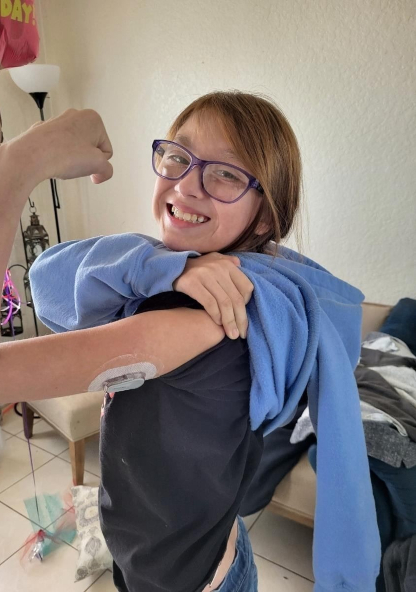
Mia Muñoz was just 5 years old when she received her first life-changing diagnosis. Eight years and two more diagnoses later, Mia’s life isn’t unfolding how her mom Amanda imagined, but together, they are learning how to thrive, with support from CHRISTUS Children’s.
“Our journey began when Mia was a baby,” Amanda explained. “She didn’t meet milestones and was a late crawler and walker. But she caught up, so I thought that was the end of it, until she started daycare at 3 years old. She wasn’t progressing as expected. She couldn’t recognize colors, which was concerning. I didn’t know where to turn, so I continued working with her on my own.”
Amanda and Mia would practice a concept one day, but Mia wouldn’t remember it the next. Amanda and Mia’s teachers had many theories: Was Mia colorblind? Did she have vision problems? Was it a learning disability?
“When Mia was in kindergarten, she got her first pair of glasses,” Amanda said. “The first thing she said was, ‘Woah! I can see my shoes!’ I was really hopeful this was the core problem and Mia would excel from there.”
A Push for Academic Testing
It soon became clear that vision wasn’t Mia’s only challenge. In first grade, she couldn’t keep up with her peers, and Amanda pushed the school to test her.
“We got approval to test her for dyslexia, but we didn’t get any answers because Mia couldn’t comprehend the test,” Amanda recalled. “That’s when I knew we were facing something more serious.”
Amanda sought testing outside of the school district, which led to Mia being diagnosed with a moderate intellectual disability, which affects how she learns and retains new information.
“It was a lot to process, but it also gave us clarity,” Amanda said. “We finally understood the type of support Mia needed and why, and we could start focusing on how to help her succeed.”
With accommodations at school, Mia began to find her rhythm. She played sports, explored art and joined Girl Scouts, where she built confidence and social skills. Just as the family found some stability, Mia faced a second life-changing diagnosis.
A School Accident and a Diabetes Diagnosis
“She was almost 11 years old and was in the fifth grade, when she had a urinary accident at school,” Amanda explained. “That immediately concerned me given her age, so I made an appointment with a urologist. At that appointment, they told me that Mia had glucose in her urine and referred me back to her pediatrician. They also scheduled urodynamics, which drew my focus. I didn’t think the glucose finding had anything to do with her accident.”
Urodynamic testing—used to evaluate how the bladder and urinary system are functioning—showed normal results, but the presence of glucose in Mia’s urine was noted again.
“At our next pediatrician appointment, I mentioned the glucose findings, so they did a fingerstick blood sugar test,” Amanda said. “Mia’s blood sugar level was dangerously high, so they told me to take her to the CHRISTUS Children’s emergency room immediately.”
Amanda was shocked when Mia was diagnosed with Type 1 diabetes, an autoimmune condition in which the body attacks the cells that produce insulin, the hormone needed to turn food into energy.
“I kept thinking it had to be something else, that it’s not diabetes,” Amanda recalled. “But, I also knew there was nothing else it could be regarding her blood sugar numbers,” Amanda recalled. “As I think back prior to the diagnosis, I can see all the signs. Mia was losing weight, drinking a lot of water and going to the bathroom a lot. At the time, I thought it was weight loss due to a growth spurt or adolescent hormones.”
Understanding Type 1 Diabetes
Mia was calm as she received her first injection of insulin, while Amanda says she did all the crying.
“It’s normal for parents to feel something akin to grief when their child is diagnosed with Type 1 diabetes,” explained Dr. Monica Dussan, pediatric endocrinologist and division chief of Pediatric Endocrinology at CHRISTUS Children's. “It’s a lifelong condition with no cure, and it requires ongoing management throughout the day and night. But I always remind families that they are in the right place and supported by a dedicated care team. There are many reasons to approach Type 1 diabetes with hope.”
Type 1 diabetes affects about one in 350 children in the United States. Mia exhibited all the common symptoms—weight loss, increased thirst, frequent urination and accidents post-potty training. Dr. Dussan advises parents to seek medical treatment right away if their child has any of these symptoms.
“When the body can’t use food for energy, it begins breaking down other sources, like fat and muscle, which produces an acidic substance known as ketones,” Dr. Dussan said. “When too many ketones build up in the blood, the body can become acidic, which is a life-threatening condition known as diabetic ketoacidosis. While we can’t prevent Type 1 diabetes, we can prevent diabetic ketoacidosis.”
Diabetes Support with CHRISTUS Children’s
A Type 1 diabetes diagnosis comes with a steep learning curve, which is why CHRISTUS Children’s has a unique program to help children with diabetes, supported by comprehensive video materials and a multidisciplinary team.
“Education is key,” Dr. Dussan said. “Each member of the team teaches parents and children not just what to do, but how it all works together. For example, a dietitian teaches them how to calculate carbohydrates in a meal, their endocrinologist determines the amount of insulin needed based on the carbs, and a certified diabetes care and education specialist will teach them how to calculate the dosage and safely administer the insulin injections. After we cover the basics, we’ll discuss more complicated situations, such as what to do if blood sugar levels get too low or too high, how to adjust for exercise, or what to do if the child is sick.”
“What scared me the most when Mia was diagnosed was thinking about how she would understand and manage this condition on top of her intellectual disability, especially when I’m not there,” Amanda said. “Between counting carbs and calculating insulin, that’s a lot of math for a child who already has academic challenges.”
Together, Amanda and Mia learned how to count carbs, calculate Mia’s insulin dose and administer the injections. About six months after her diagnosis, Mia switched from injections to an insulin pump. Paired with her continuous glucose monitor, the two devices work together to help regulate her blood sugar day and night.
“I wanted the pump right away,” Amanda admitted. “In my mind, it felt safer and made me more comfortable, but Dr. Dussan encouraged us to wait. She wanted both of us to feel confident with counting carbohydrates, calculating insulin doses and giving injections in case technology ever fails. I’m thankful for that guidance, because now both Mia and I are confident. In fact, Mia has excelled at managing her diabetes, especially at school where she comfortably speaks up when she needs to go to the nurse to manage high or low blood glucose.”
Moving Forward with Diabetes and Vision Loss
In 2025, Mia received yet another diagnosis: pigmentary retinal dystrophy, a condition that causes peripheral vision loss and can progress over time.
“Mia’s vision is stable for now, but there is no cure, so there is always a chance that her condition could progress to the point that she is considered legally blind,” Amanda explained. “That makes me more intentional about the little things we do, like looking at holiday lights or full moons, playing basketball together or even Mia practicing her driving skills. I want her to have memories that she can always see in her mind.”
“I remember the first time I met Mia and Amanda and being wowed by their relationship,” said Meredith DeFrees, PA-C, pediatric endocrinology physician assistant at CHRISTUS Children’s. “There’s so much love and care there. Amanda has stepped up in every way to support Mia and help her succeed. I also get so excited every time I see Mia. She isn’t defined by her challenges and is always so sweet and kind. It’s truly an honor to be a part of their care team.”
“I really am so proud of both Mia and Amanda,” Dr. Dussan said. “Amanda has helped Mia maintain incredible control of her diabetes, which can be difficult. Amanda doesn’t hesitate to open up to us when she’s struggling with something. That kind of connection, letting us truly be a part of their journey, is one reason why they feel like family to us.”
“We also think of Dr. Dussan and Meredith as family,” Amanda said. “Every appointment is like a mini therapy session for me because they always ask, ‘Tell me about you. How are you doing?’ There is a physical and emotional toll to having a child with Type 1 diabetes, and they are intentional about taking care of both of us.”
Looking back, Amanda no longer feels the overwhelming fear she felt the night of Mia’s diabetes diagnosis.
“There are still worries, especially now with the possibility of losing her vision,” Amanda said. “How will she count carbs, check her numbers or use her pump if she can’t see? But Mia has me, her dad and brother, our immediate family and our family at CHRISTUS Children’s. Of course, we’re going to have hope with a team like this!”
At CHRISTUS Children’s, no family faces diabetes alone. To learn more about pediatric endocrinology services and comprehensive Type 1 diabetes care at CHRISTUS Children’s, visit Pediatric Endocrinology | CHRISTUS Health.